

 Address to
The course is addressed to Physiotherapists and other Health Professionals.
Course Language
The language of the seminar will be English, and simultaneous translation will be available.
Information
LLLC, EPIMORFOSIS intends to organize Scar Therapy Practitioner Course in cooperation with Restore Scar Therapy with Tina Glynn as a tutor.
The Seminar Lasts 3 days and will be held in Athens on 4 – 6 September 2026.
The cost of the seminar is 480€.
The amount of 180€ must be prepaid for the finalization of the participation.
The remaining amount of 300€ must be deposited at least two days before the start of the seminar.
Course Details
Enhance your clinical practice with evidence informed skills to assess, treat and support clients with all types of scars.
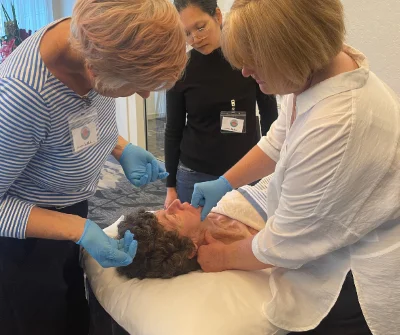
The Scar Therapy Practitioner course is a comprehensive, hands on training programme designed to integrate seamlessly into musculoskeletal, post operative, burns, trauma and rehabilitation settings.
Through a blend of practical workshops and concise online learning, you will develop confident, safe and effective scar treatment strategies—enabling you to improve mobility, reduce pain and sensitivity, influence tissue behaviour and optimise functional recovery for both new and historic scars.
Essential Knowledge
• Scar terminology and classification relevant to clinical assessment
• Wound healing and scar formation
• Common complications following surgery, trauma and burns
• Considerations for planned, emergency and trauma-related procedures
• Contraindications to scar massage
• Negative pressure (cupping/vacuum) therapy theory
• Contraindications to negative pressure
• Scar creams, oils and gels – evidence and application
• Treatment planning and further reading for current research in scar therapy
Clinical Skills to Enhance Patient Outcomes
Advanced Massage & Fascial Techniques
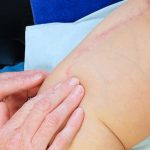
• Methods to soften and reduce dysfunctional or adhered scar tissue
• Techniques to improve skin and fascial mobility
• Approaches to reduce hypersensitivity and pain
• Adaptations for:
o Surgical scars (including emergency procedures)
o Burn scars
o Adhered or restricted scars
o Cosmetic scars
Restore Movement and Flexibility
• Safe, structured stretching strategies for different scar types
• Techniques to enhance tissue mobility and glide
• Methods to improve range of movement
• Progression approaches for each healing stage
Advanced Tissue Mobilisation
• Suction-based treatment applications
• Techniques to lift, loosen and shear restrictive tissue
• Approaches to address adhesions
• Methods to encourage blood flow and tissue remodelling
Specialist Facial Scar Treatment
• Internal mouth/intraoral techniques (safe and structured)
• Approaches to work with deeper tissue layers
• Clinical considerations following facial injury or surgery
Support Ongoing Remodelling
• Restore kinesiology taping applications
• Techniques to influence tension, load and direction of force
• Methods to support tissue healing outside the clinic
• Home-use kinesiology taping guidance
Empower Patients for Better Long Term Outcomes
• How to teach self massage effectively
• Guidance on selecting suitable topical products
• How to create tailored home-care programmes
• Treatment progression strategies for continued improvement
2.webp)
You can find more information in web site: https://restoretherapy.co.uk/
Time Schedule
Day 1 08:30 – 09:00 Welcome & orientation. Day 2 08:30 – 09:00 Welcome, review of Day 1 and outline of the day. Day 3 08:30 – 09:00 Welcome, review of Day 2 and outline of the day.
09:00 – 09:40 Theory: Wound healing and scar formation.
09:40 – 10:30 Structured scar assessment and movement-based assessment including visual characteristics, tissue mobility and differential glide, directional restriction, sensory and symptom response, and functional impact.
10:30 – 10:50 Break
10:50 – 11:30 Theory: Scar classifications and treatment considerations. Clinical considerations for injury: traumatic injury vs planned surgery (interactive discussion).
11:30 – 12:30 Practical: Foundational manual techniques – pumping and stroking to improve tissue hydration and prepare the tissue for stretch (demonstration and partner practice).
12:30 – 13:30 Lunch break
13:30 – 14:10 Theory: Treatment reactions – what to expect? Recognising normal responses and when to modify treatment.
14:10 – 15:00 Practical: Application of techniques and exploration of scar mobility (demonstration and partner practice).
15:00 – 15:20 Break
15:20 – 16:45 Treatment demonstration: Clinical reasoning in practice – live assessment, technique selection, dosage, and progression planning.
16:45 – 17:00 Questions
09:00 – 09:40 Theory: The impact of adhesions on skin and fascia.
09:40 – 10:30 Practical activity: Exploring tissue mobility and adhesions (demonstration and partner practice).
10:30 – 10:50 Break
10:50 – 11:20 Theory: Scar stretch techniques – exploring mobility and extensibility with active and passive variations.
11:20 – 12:30 Practical: Application of scar stretch techniques (demonstration and partner practice).
12:30 – 13:30 Lunch break
13:30 – 14:10 Theory: Use of negative pressure in scar therapy. Silicone cupping as a manual tool to influence tissue mobility – considerations, cautions, and indications.
14:10 – 15:00 Practical: Silicone cupping application for improving tissue mobility (demonstration and partner practice).
15:00 – 15:20 Break
15:20 – 15:50 Theory: Silicone, compression and topical scar products – product selection, indications, and integration within rehabilitation.
15:50 – 16:30 Treatment demonstration: Clinical reasoning in practice – live assessment, technique selection, dosage, and progression planning.
16:30 – 16:50 Practical: Unwinding technique (demonstration and partner practice).
16:50 – 17:00 Questions
09:00 – 10:00 Activity: Assessment, planning, and technique progression (group activity with case-based problem solving).
10:00 – 10:15 Break
10:15 – 11:15 Kinesio Taping to alter tensional forces in scars (demonstration and practical application).
11:15 – 12:15 Intraoral techniques for facial injury (demonstration and practical application).
12:15 – 13:00 Lunch break
13:00 – 14:00 Technique review and discussion.
14:00 – 14:45 Live treatment demonstration: Clinical reasoning in practice – live assessment, technique selection, dosage, and progression planning.
14:45 – 15:00 Break
15:00 – 16:30 Supervised clinical practice session: Participants assess and treat a patient under guidance.
16:30 – 17:00 Final questions.
Teachers
 ViewCV
Ways of Payment
ViewCV
Ways of Payment
1. Credit or Deposit card payment
You can deposit the down payment or the total fee via credit or deposit card (Visa & Mastercard) from the webpage of each course, through VivaPayments.
You are solely responsible for the proper entry and the genuineness of your credit/deposit card’s details. EPIMORFOSIS bears no responsibility in case of any error.
2. Deposit – Transfer to our bank account.
Since the banking system now requires Verification of Payee (VoP) for every transaction, for your convenience, you may complete it using the TAX REFERENCE number of EPIMORFOSIS, which is 800551451
You can deposit or transfer the requested amount for your registration to the following accounts, writing your full name in the field “Reason for the Beneficiary”:
PIRAEUS BANK:
ΙΒΑΝ: GR5501722380005238070348955
SWIFT(BIC): PIRBGRAA
NATIONAL BANK of GREECE:
IBAN: GR6801102170000021744103439
SWIFT(BIC): ETHNGRAA
ALPHA BANK :
ΙΒΑΝ: GR4801407080708002002013410
SWIFT(BIC): CRBAGRAA
EUROBANK:
ΙΒΑΝ: GR4502600370000010201090153
SWIFT(BIC): ERBKGRAA
Beneficiary: EPIMORFOSIS KENTRO EPIMORFOSIS STELECHON YGEIAS OE
3. Payment via IRIS.
You can complete the payment for your order through the IRIS online payment service.
TAX REFERENCE EPIMORFOSIS: 800551451
The bank transfer fee charged to EPIMORFOSIS
Terms of Participation
1. A certificate of attendance, a degree or a diploma will be issued.
2. Printed handouts are provided (notes or relevant book).
3. In case of cancellation of the seminar due to EPIMORFOSIS’s responsibility, deposited fees will be refunded immediately.
4. EPIMORFOSIS reserves the right to change the date or postopone seminars, informing participants by phone and / or sms & e-mail. In such a case participants are entitled to request full refund of their fees if they do not wish to attend the seminar on the new date or to use this amount for their participation in other seminars or services of the company.
5. In the event of a strike, government’s bans, heavy bad weather, and generally any event beyond the reasonable control of the organisers which impedes the execution of part or all of the seminar, the organizers reserve the right to change the date and time of the event. In this case the fees are not refundable but are valid as they are.
6. Cancellation of participation due to participant’s responsibility is possible only by email, as follows:
• up to 30 days prior to the start of the seminar, all deposits are refundable.
• up to 15 days prior to the start of the seminar, 50% is refundable.
• no refund after this deadline, exceptions could be only by decision of EPIMORFOSIS.
7. The realisation of the course will be confirmed by email or/and sms to be sent to participants, in time.
8. It is advised to not buy your flight tickets until you receive this confirmation email (or/and sms).
9. LLC EPIMORFOSIS keeps the right to change course venues.
Hotels
Hotel Delfini**
More information: Tel.: +30 210 94 15 364 & 94 15 373
Map
Σεμινάριο Πιστοποίησης στην Θεραπεία Ουλών – ΑΘΗΝΑ 2026
Price range: €180.00 through €480.00
EPIMORFOSIS justifies its name by providing high quality courses. George Karampalis operates more like a constant “trainee” and less like an entrepreneur, and this is an additional positive fact in the effort that is put by the workers and teachers of EPIMORFOSIS.
I have known George Karampalis and EPIMORFOSIS for many years. I’ve had the opportunity to join several clinical courses and I can argue that, at the level of organisation and selection of trainers, they have a high level of recognised prestige.
My first steps in professional specialization started with EPIMORFOSIS and continue. It has been with us all these years, covering the need for modern and documented knowledge, in collaboration with internationally acclaimed educational institutions.
The best physiotherapists training institution. It enables the development of the necessary knowledge for clinical reasoning. High-quality training without having to travel abroad.
Training, a steady value for more than twenty years now, leads physiotherapy and keeps it at a very high level, well done to George Karambalis and his associates, we owe a lot to all of you.
EPIMORFOSIS organizes specialization seminars for rehabilitation professionals. I’ve watched a lot. I strongly recommend you trust EPIMORFOSIS for your specialization and lifelong information.

 Smart
Smart